



In an era where daily news feeds swing wildly between AI-driven corporate transformations and economic uncertainty, HR and business leaders face a profound dual challenge.
On one side, executives look at headlines about cutting roles to fund AI through the lens of smart capital allocation. On the other side, employees wonder what it means for their families, their mortgages, and their day-to-day stability.
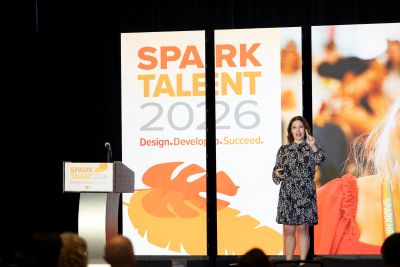
According to Christine Walsh, Head of Global Talent at American Express Global Business Travel (Amex GBT), navigating this tension requires mastering a fundamental mindset. As Walsh put it during her keynote:
“Two things can be true at once, and my argument for today is two things can be true at once. We can be both high technology and high touch, and the people that get it right do them both. They do them in partnership, and they do them intentionally.”
Balancing 28,000 remote-first colleagues, 111 years of customer service legacy, and massive technological evolution, Amex GBT approaches the modern employee experience through four core pillars.
1. Colleague Listening: Closing the Loop with “You Said, We Did”
According to data from Perceptyx, organizations are surveying employees more frequently than ever, with 75% conducting surveys quarterly or more. Yet, data from Gallup reveals that only a quarter of employees strongly feel their opinions actually count at work.
The disconnect isn’t that companies don’t care; it’s that they often fail to connect the dots. Walsh emphasized that listening only works when you relentlessly and unapologetically close the loop. By asking employees directly—“If you started with a blank sheet of paper and built something meaningful, what would you want? What would you need?”—and redesigning onboarding into a streamlined 100-day program, completion rates skyrocketed past 80%.
Furthermore, Walsh highlighted how technology can ease the administrative burden of listening:
“I don’t know about you, but I am delighted that I don’t have to read thousands and thousands and thousands of comments to get sentiment. I can throw them into an AI tool, get trends, get sentiments, get recommendations of actions. That’s a great, that’s a great use for, um, some of the technology that we’ve talked about.”
2. Shifts in Work: Reimagining Roles and Building Talent In-House
AI and automation are reshaping job descriptions across every industry. While headlines spark fear of total job displacement, World Economic Forum data points to a net positive shift in jobs by 2030, driven by massive job creation and evolution.
When external talent pools dry up or specialized skill sets become rare—such as veteran travel counselors managing complex after-hours VIP services—companies cannot simply rely on hiring from the outside.
“We cannot rely on this buy model. We have to go build it,”
Walsh explained, highlighting how Amex GBT created internal solutions like their “travel academy” to teach new hires the necessary technology and tools from scratch, drastically reducing time-to-offer and building a sustainable talent pipeline.
3. Skill Development: Making Learning a Habit, Not an Event
Most organizations rate their skill development programs as mediocre when measured against future business needs. Employees know they must future-proof their careers, and if an employer isn’t investing in their growth, they will look elsewhere.
To combat this, Amex GBT shifted learning from a rare, formal event into an everyday routine by leaning into psychological principles of behavioral design:
“Anybody read the book Nudge? It’s a terrific book, right? It’s how do you get people to do what you want them to do without even them feeling like it’s a conscious choice they’re making? How do we make it so easy for them?”
By embedding bite-sized, micro-learning directly into daily workflows (such as automated one-minute learning modules during natural breaks), organizations can make continuous learning an effortless habit rather than a chore.
4. Purpose and Belonging: Treating Connection as Infrastructure
With over 90% of Amex GBT’s US workforce operating remotely, connection cannot be left to chance. Research from Gallup highlights that the rate of loneliness among fully remote workers has climbed to 25%, proving that remote-first models require intentional infrastructure rather than organic watercooler moments.
Walsh noted that building real connections remotely takes deliberate effort, sharing a personal reflection:
“I’m so sorry, but have we met before? I, I can’t remember if we’ve met in person or not… And it’s not because I don’t value meeting them in person. It means we’ve been able to build a meaningful relationship through remote work.”
Amex GBT supports this by establishing 90 structured remote communities backed by dedicated leadership and budgets, alongside global social impact partnerships with organizations like Airlink to rescue people in crisis. By asking the critical question—“Are we doing the right things in the right way for the right people?”—employers build resilient, engaged teams.
Bringing Ideas Home
Ultimately, navigating an era of rapid transformation comes down to intentionality. Reminding leaders of the company’s core ethos, Walsh concluded:
“At American Express Global Business Travel, we’re a group of people that believe that great ideas travel… I hope you’re walking away with one or two great ideas, and those ideas travel home with you and make their way into your own organizations.”