Tag: Employment law

Supreme Court

What Employers Should Know About Recent TPS Changes

On June 25, 2026, the United States Supreme Court issued its decision in Mullin v. Doe, in which the Court allowed the Trump administration to proceed with the termination of temporary protected status (TPS) designations for Haiti and Syria. Under the TPS statute, which was enacted in 1990, the Department of Homeland Security (DHS) Secretary […]


Bias, Bots and Boundaries: Practical Tips for Avoiding Liability in AI Recruiting

Artificial intelligence can make recruiting faster, but legal responsibility does not disappear when technology enters the hiring process. That point is being tested in Mobley v. Workday, Inc., Case No. 3:23-cv-00770- RFL (N.D. Cal. 2023), a federal lawsuit pending in the Northern District of California, in which job applicants allege that Workday’s AI-based applicant-screening tools […]

5th Circuit Rules Employee With 27 Work Deficiencies Still Makes It to Jury

You read the headline right: Despite 27 workplace violations, a three-judge panel from the U.S. 5th Circuit Court of Appeals (the federal appeals court for Texas) decided the employee still gets to take her Americans with Disabilities Act (ADA) and Family and Medical Leave Act (FMLA) claims to trial. Yes, it was by a 2-to-1 […]

Telework as a Reasonable Accommodation: Recent EEOC Guidance for Employers

Disability accommodation claims have long been among the most common workplace discrimination claims, but the recent increase has been unusually sharp. One major driver is telework as a requested reasonable accommodation. For employers managing return-to-office expectations, the practical question is whether there are lawful ways to evaluate, limit, modify, or deny telework requests when appropriate. […]

Union Contracts Are Becoming HR AI Playbook 

HR leaders should watch an unexpected source of practical AI policy: collective bargaining agreements. A July 2026 Axios review found that the NewsGuild-CWA had roughly 85 to 90 contracts with explicit AI provisions. Those workplace AI rules matter beyond unionized employers because they show how employee participation can become part of deployment rather than a […]

End of an Era? EEOC Votes to Scrap 60-year-old Demographic Reporting Requirements

On July 21, the U.S. Equal Employment Opportunity Commission (EEOC) voted to approve a draft notice of proposed rulemaking that would rescind the EEO-1 report and related demographic data reporting requirements, ending an obligation that has been a fixture of federal employment compliance for six decades. While the proposal must still navigate the notice-and-comment process […]

IT

Pay Attention to This Texas Distracted Driving Phone Sex Case

Distracted driving is a huge issue in the United States, causing large numbers of crashes and deaths every year. But what happens when distracted driving results in a crash from an on-the-job employee? Can the employer be held responsible? What can employers do to protect themselves? Distracted Driving Thomas Earl Roberts was a commercial tractor-trailer […]

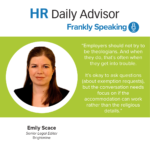
HRDA Frankly Speaking: HR Leadership Shouldn’t Include Theology

Religious exemptions requests of AI are growing by the day. Since May, when the Vatican released an encyclical offering criticism on AI and its use, several instances of employees successfully acquiring religious accommodations to avoid using AI have been popping up, and likely many more to follow. What does this mean for employers? Well, thanks […]

FMLA

Wayfair PFML Verdict: Five Lessons Every HR Professional Should Take Seriously

Recently, a Massachusetts superior court jury awarded $4.75 million to an employee in a case against her former employer, Wayfair. The verdict has become one of the most significant employment law developments for Massachusetts employers since the Paid Family and Medical Leave (PFML) law took effect in 2021. The substantial verdict under PFML’s antiretaliation provision […]

SCOTUS Clears Path for TPS Terminations—What Employers Need to Do Now

The Supreme Court of the United States (SCOTUS) recently decided in Mullin v. Doe that federal courts generally lack authority to review Department of Homeland Security (DHS) decisions to terminate temporary protected status (TPS) designations. This decision clears the way for DHS to move forward with terminating TPS protections for several countries. Here’s what employers […]