




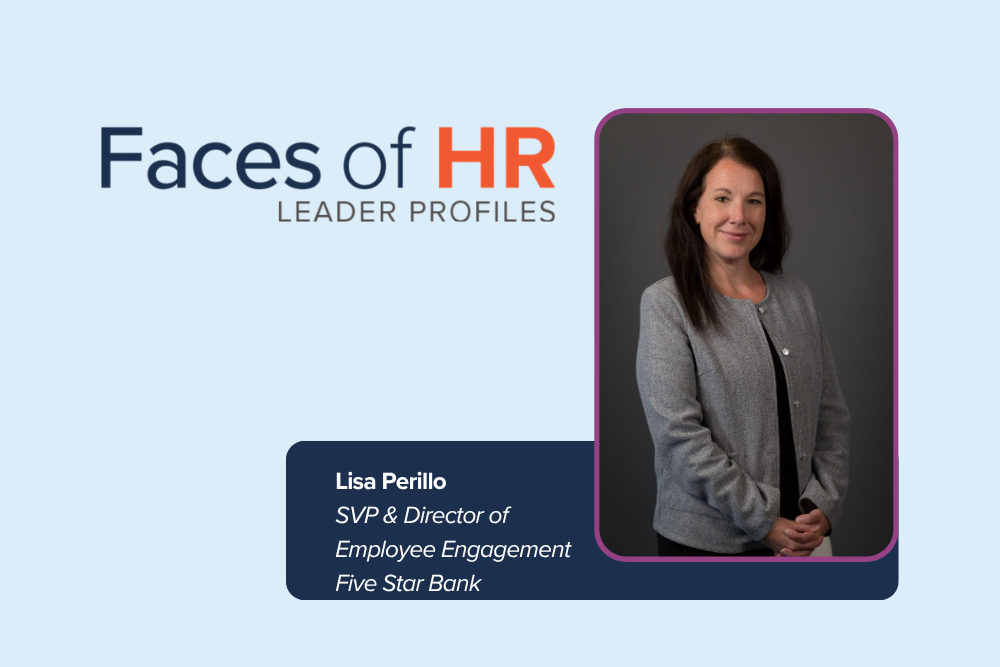
Lisa Perillo‘s path to leading human resources (HR) at Five Star Bank didn’t start in a traditional HR back office. It began on the ground floor of operational banking. Early in her career, Perillo developed a firsthand appreciation for how business performance, leadership effectiveness, and employee engagement intertwine. She quickly saw that a thriving business relies on engaged employees, effective managers, and a culture built on trust and accountability.
Guided by a Passion for Growth
Driven by a desire to help her peers build confidence and master new skills, training, coaching, and mentoring became natural extensions of her management style. As she advanced, Perillo found herself frequently called upon to coach leaders, support teams, and help employees grow. When the chance came to bring her hard-earned operational background directly into HR, she jumped at the challenge—using her insider understanding of the business to shape people strategies that drive real results.
Elevating the Entire Employee Experience
Six years ago, Perillo made a deliberate pivot to focus on leadership development as a way to elevate the employee experience across the entire organization. That role expanded two years later to encompass oversight of the full HR function at Five Star Bank.
Today, as SVP and Director of Employee Engagement, Perillo oversees the complete employee life cycle—from recruitment and benefits administration to learning and development, employee relations, and talent initiatives.
By building strong programs, strategic partnerships, and leadership practices, she remains focused on supporting employees, strengthening bank culture, and positioning the organization for long-term growth.
In our latest Faces, meet Lisa Perillo.
Who is/was your biggest influence in the industry?
Surprisingly, my biggest industry influence wasn’t an HR professional. Taking a collective look at the leaders within my organization had the biggest impact on me. Our executive team, especially our female executives, embody grace, grit, and empathy with a drive that pushes me every day.
What’s your best mistake and what did you learn from it?
My best mistake was staying quiet in a situation that required me to speak up because I wasn’t the most senior leader in the room. As the situation unfolded, it helped me to realize the importance of having a voice when I was the subject matter expert and the information that I held was unique to the decision-making process. It was a powerful lesson I learned early in my role as the leader in the HR space.
What’s your favorite part about working in the industry? What’s your least favorite part, and how would you change it?
My favorite part is the people and getting to learn all of the great things that HR leaders are doing for their employees and the industry. I get so many ideas from other leaders, and there is such a willingness to collaborate amongst HR professionals.
My least favorite part is the stigma around HR and how HR teams manage their workforce. To change this view, our leadership teams need to engage HR in business operations, and our HR teams truly need to care about its people and their growth.
It sounds like through your experience you really care about people, and you want to help them feel safe and comfortable, which is important in the industry. Please elaborate here.
Taking the time to build relationships, give support, and show up for our employees is what matters the most. I often tell my team that we have the responsibility to show up on the best and worst days of our employees’ lives. Whether we are delivering the offer letter for an incredible new opportunity or share that today is the final day of employment, we must recognize the empathy required. If we don’t truly care about the success of everyone, we miss the opportunity to impact lives in a positive way.
How can company leaders make HR a value within their organization?
Engage the HR team, share values, and create a strategy that empowers HR to engage with the workforce. HR should not be seen as a barrier to success, but a key component to engagement. Bringing HR into the organizational strategy with the critical role of engaging employees and committing them to the company’s success is a key indicator of performance. If we understand the business and its goals, we can drive that in manager support, talent development, and key conversations that move the needle.
Where do you see the industry heading in five years? Or are you seeing any current trends?
The industry is heading into HR being more of a strategic partner and a key driver in success and engagement. We will no longer be needed for the small administrative functions, but instead be true business partners that have a responsibility to develop talent, challenge workforce, and have a key stake in bottom line success as we navigate the AI shift and its role in organizational growth.
What are you most proud of?
We hire great talent, actively engage them, and continue to maintain a culture of support and execution. Considering I had no HR experience beyond being a manager when I took this role and had to learn all the ins and outs of HR, from legal frameworks and benefits to recruiting and engagement, we have built a robust employee experience that I am really proud of.
Do you have any advice for people entering the profession?
Find your own personal board of directors filled with champions, cheerleaders, and sounding boards that allow you to be strategic and can provide feedback that, while hard to hear, is critical to your personal growth. Find your voice, know when to use it, and build relationships that help drive your development.