




When Tim McNicholas began his career in management consulting, he didn’t necessarily predict the he would end up shaping executive leadership for major global organizations. But a key turning point came during his time at Siemens Corporation’s global headquarters.
There, McNicholas was tasked with a high-stakes challenge: designing a high-potential recruiting program directly for the CEO. That pivotal project launched a series of major talent initiatives, including a complete redesign of the education program for senior executives.
As his time in Munich, Germany, drew to a close and he began planning his return to the United States, McNicholas set his sights on a new horizon: executive search and leadership advisory.
He found his natural groove after joining Egon Zehnder. McNicholas gravitated toward working alongside senior human resources leaders, eventually dedicating his entire focus to the HR function.
“I’ve led the firm’s HR practice in the U.S. for many years and have watched as the human resources function has become more critical across industries,” McNicholas reflected on his time with the firm.
Fast-forward through years of growth and change, and McNicholas remains at the forefront of a discipline that continues to transform businesses on a global scale.
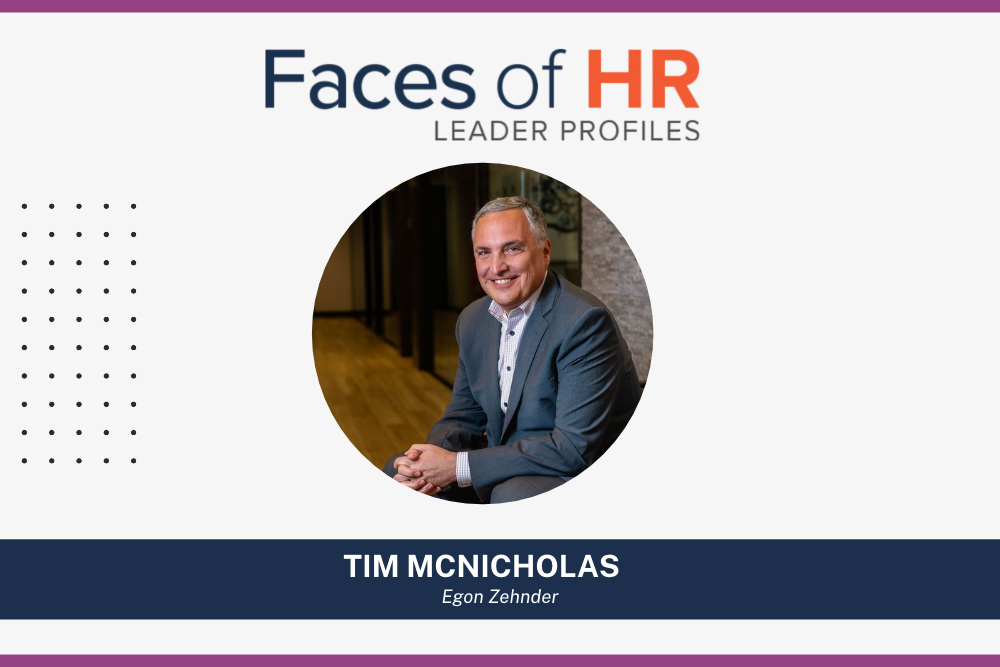
In our latest Faces, meet Tim McNicholas.
Who is/was your biggest influence in the industry?
I’ve had several important mentors throughout my career, but a critical influence and central figure in my decision to enter executive search was a senior executive at Siemens Corporation. He had previously worked in the industry and strongly encouraged me to meet with Egon Zehnder to explore the career path.
As for important influences from the HR community, there are too many to identify just one. Having the opportunity to network across different industries has exposed me to a few incredibly strategic, curious, and insightful human resources executives.
What’s your best mistake and what did you learn from it?
My best mistake was taking a role at a management consultancy where the culture and the values of the firm did not align with mine. I was a young parent, working many nights and weekends, and I found myself unsatisfied and unhappy. With the support of my wife, I found myself reevaluating what was important in my career and life. That experience helped expose me to an organization that was a much better fit, eventually providing me the opportunity to live outside of the U.S. and broaden my cultural awareness.
What’s your favorite part about working in the industry? What’s your least favorite part, and how would you change it?
My favorite part about working with people in the human resources industry is the amount of impact that chief people officers can have on an organization, compared with what was possible a decade ago. My least favorite part is not having enough great leaders in the function (at all levels) to satisfy many organizations’ new and evolving need for strategic HR leaders. Within executive search, my favorite part is hearing about all of the new, creative strategies great leaders are bringing to their organizations.
It sounds like through your experience you really care about people, and you want to help them feel safe and comfortable, which is important in the industry. Please elaborate here.
The executive search business has evolved over time from a business of search to a business focusing on fit, meaning we spend more time understanding a candidate from a broadly defined perspective including values, drivers, and self-identity. Our industry needs to have leaders who genuinely care about people and want to help them find the best environment to bring their entire self to work. It’s incredibly gratifying to help both a client and a candidate find the perfect fit.
How can company leaders make HR a value within their organization?
In my experience, HR leaders are involved in many enterprise topics outside the traditional definition of human resources. I’m old enough to remember discussing having a seat at the table, which no one says anymore. CEOs now want greater impact from their human resources teams, and they want those teams to drive transformation and culture. Human resources has never had a greater opportunity to impact company strategy.
Where do you see the industry heading in five years? Or are you seeing any current trends?
Like most industries, the executive search industry will look very different five years from now. Even predicting where we will be in two to three years is challenging, given the adoption of AI across all phases of the sector. I expect that human judgment, and trusted relationships will be at the center of the companies that succeed in the future, but how the work gets done will likely be unrecognizable to the people in the industry today, let alone a decade ago.
What are you most proud of?
I’m most proud of the people I’ve helped and the impact I’ve had on their careers. Given how hard people work in human resources and how challenging the role has become, I find that people have a strong need to see their effort translate into impact. Helping an individual find the ideal combination of role and values, and giving them the opportunity to have a bigger impact through their work, is incredibly satisfying. The second thing I’m most proud of is helping create meaningful organizational change that leads to stronger business performance.
Do you have any advice for people entering the profession?
The most important advice I have for people entering the executive search industry is to make sure you have a great deal of resilience and are ready for significant changes that are likely to impact both our business and our clients. The same advice applies to people entering the human resources profession.