


In today’s fast-moving business world, skills are shifting faster than most organizations can keep up. Artificial intelligence (AI) is rewriting how work gets done, and traditional HR playbooks are struggling to keep pace.
Enter a game-changing concept for talent development leaders: Talent Velocity.
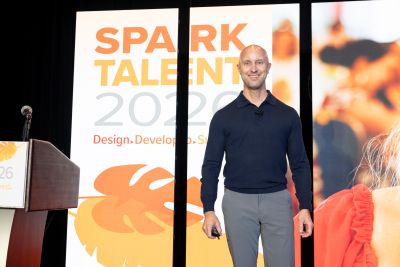
Introduced by SPARK TALENT speaker Kevin Bishop, Director of Talent Development at LinkedIn, talent velocity is shaking up how companies think about workforce agility. Drawing directly from insights in LinkedIn’s Talent Velocity Advantage report, Bishop explored what this concept means for modern organizations and how HR leaders can turn it into a practical strategy.
What Is Talent Velocity?
At its core, talent velocity is an organization’s ability to quickly see its skills, build or acquire what is needed, and mobilize talent in real time.
According to data featured in LinkedIn’s report:
- 86% of organizations lack adequate talent velocity.
- Only 14% have figured it out, earning the title of “Talent Velocity Leaders.”
As Bishop pointed out during the session, there is no single cookie-cutter recipe for success:
“Every organization is unique. Every organization is going to embody talent velocity a little bit differently, but there are some things we’re gonna talk about today that are common, that can help you really bring that to life.”
Organizations that master this velocity experience a massive confidence advantage over their peers. The report reveals that Talent Velocity Leaders report significantly higher confidence in aligning talent to changing priorities (+36 pts), attracting critical talent (+27 pts), retaining critical talent (+26 pts), and overall profitability (+23 pts).
The 5 Accelerators of Talent Velocity
How do talent leaders pull ahead? According to the framework outlined in LinkedIn’s report, driving velocity relies on putting employee growth at the center of organizational transformation through five key pillars:
- Leadership Momentum: Treating career development as a core business imperative rather than a nice-to-have perk. As Bishop notes, leaders in high-velocity organizations believe that “career development isn’t just a perk, it’s a business imperative.”
- Culture as a Catalyst: Cultivating a workplace that genuinely rewards curiosity, learning, experimentation, and growth.
- Leading on AI: Providing targeted AI tools and skill-building opportunities tailored to specific roles.
- Integrated Talent Ecosystems: Breaking down internal silos so different HR and talent functions collaborate seamlessly.
- Career Power: Empowering employees to take control of their own career progression with personalized support.
Where Does Your Organization Stand?
To diagnose where a company sits on the journey, LinkedIn maps progress across The Talent Velocity Curve:
- Level 1 (Static): Bogged down by daily tasks; struggling to prepare employees for the future.
- Level 2 (Planning): Leaders recognize the need for change and have ideas, but nothing is operationalized yet.
- Level 3 (Progressing): Piloting initiatives across accelerators, but clear results aren’t visible yet.
- Level 4 (Emerging): Activating across all five accelerators and seeing initial results.
- Level 5 (Leaders): Full system transformation with proven, documented results.
When assessing where an organization falls along the curve, Bishop noted that progress can vary widely across different areas:
“You can look at one accelerator and think that you’re at level four, and you could look at another one and think, ‘Ah, we’re probably at level two,’ with regard to that one, right? So really, this is meant to be a directional guide for you as you think about where you wanna focus your efforts to help accelerate talent velocity within your organization.”
How LinkedIn Practices What It Preaches
If you want to build talent velocity, it helps to look at how organizations like LinkedIn bring these accelerators to life internally:
- Building Momentum from the Top: Every two weeks at all-company all-hands meetings, LinkedIn spotlights new hires to share their stories alongside long-tenured employees discussing how their career journeys expanded internally.
- Simplifying Culture: Moving beyond dense corporate value statements to a simple, memorable standard. As Bishop highlighted, LinkedIn’s culture is rooted in a clear philosophy:
“We dream big, we get shit done, and we know how to have fun.”
- Empowering AI Fluency: Moving away from broad, generic training to gamified programs like Mission AI (where employees earn badges for participating in challenges) and rolling out function-specific AI transformation plans.
- Connecting Ecosystems: Utilizing centralized platforms like LinkedIn Learning’s Career Hub as a one-stop shop for roles, skills, and internal mobility.
- Unlocking Career Power: Providing new hires with an AI Coach for live role-playing scenarios, alongside access to 1-on-1 professional coaching for every employee.
Starting Small: Turning Theory into Action
The biggest trap in talent development is trying to solve everything at once. When tackling massive initiatives—like building out skills architectures for tens of thousands of employees—the secret is to start small.
As Bishop advised attendees when wrapping up their action plans, focus intensely on what can realistically be achieved in the immediate term:
“Let’s focus on what you can do in the first thirty days from when you leave here today.”