



In a fast-paced corporate world, it’s easy for HR leaders to get buried in spreadsheets, compliance updates, and standard procedures. But Kevin Bishop, the Director of Talent Development at LinkedIn, believes it’s time to bring creativity, flexibility, and genuine joy back into the workplace.
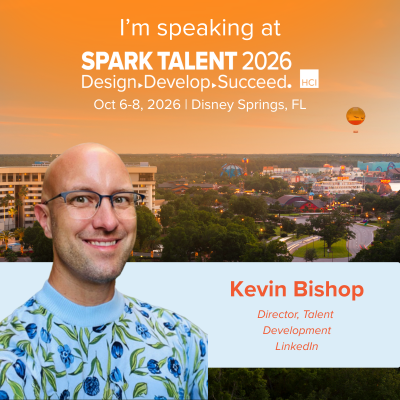
Coming from a unique, non-linear background in the performing arts (music and theater), Bishop treats his “corporate outsider” perspective as a superpower. Before he takes the main stage at SPARK TALENT this fall, here are the top 7 actionable insights from his recent interview to help HR leaders challenge the status quo, handle modern disruptions, and build a future-ready workforce.
1. Build a “Portfolio of Skills” Instead of a Career Ladder
The traditional corporate ladder—where an employee joins a company at entry-level and climbs straight up for decades—is officially gone. Bishop points out that while organizations want to retain talent, they do not always have linear promotions to offer.
“The idea that we’re gonna stay at organizations long-term, you know, and for our whole career is gone… So I think this idea of just, like, how do you collect the skills that are most valuable to you and create your brand around those skills.”
- HR’s Actionable Solution: Shift your internal development conversations. Instead of mapping out rigid vertical paths, coach employees to build a diverse portfolio of skills and a strong personal brand around those skills. This allows talent to be flexibly deployed where the business needs them most.
2. Stop Conflating “Information Transfer” with True Learning
Bishop warned against a common industry trap: assuming that giving employees instant access to information (like AI-enabled real-time tips) is the same as learning.
“Information transfer is not learning… I just want us to not conflate it with deeper learning. Learning comes from the cognitive friction that is produced when you’re trying to do something new or trying to wrestle with a new idea, and it takes time.”
- HR’s Actionable Solution: Accept that true learning takes time and mental effort. Stop expecting a single baseline workshop to magically teach a new skill. Use workshops only to set a baseline, and then build in structured time for employees to practice over time.
3. Integrate Real-World Practice and Reflection into the Job
When managers complain they don’t have time to send employees to intensive multi-day training programs, HR needs a better approach than a quick-fix presentation.
“Every person I work with tells me they don’t have time. But we have to be thoughtful as HR and learning professionals about how we integrate true learning into the work itself… I actually think the learning comes from the actual real world application of things.”
- HR’s Actionable Solution: Weave learning directly into the regular flow of work. For example, have managers add a 15-minute case study review to their existing team meetings. Discuss a real-world scenario that happened that week and talk about how the team applied their skills to fix it. Reflection is what makes learning stick.
4. Redefine AI Fluency Beyond “Good Prompting”
Many HR teams are feeling intense pressure to make their workforces “AI fluent,” but few have a clear definition of what that actually means. Bishop argues that we are past the point of just teaching employees how to write a basic prompt.
“I think for most folks we’re beyond the point of teaching them how to write a good prompt… AI fluency now, in my perspective, is more about how do you apply it to your work to be more effective. I think the piece of advice is really to just challenge the status quo, right? And try to be creative in how you’re thinking.”
- HR’s Actionable Solution: Define AI fluency as the strategic application of AI to make daily work more effective. HR leaders must look at what jobs need to be done, identify the exact skills required, and challenge traditional team structures to see where AI can support—rather than replace—human effort.
5. Don’t Automate Away the “Quick Wins” That Keep Employees Motivated
When companies use AI to automate routine tasks, they often accidentally harm employee morale. Bishop shared a case study where a company outsourced two-thirds of its easy customer service calls to AI. The human reps were left only with angry, crying, or yelling customers all day, stripping them of the easy, positive interactions that produce the dopamine needed to enjoy their work.
“We have to be really thoughtful about how we’re applying AI… There’s a lot of chatter about automating some of the most routine parts of people’s jobs, and that makes them more productive. But does it? Because actually when you take away the quick wins people have throughout the day, you just leave them with the really hard stuff.”
- HR’s Actionable Solution: Be incredibly thoughtful when deploying AI tools. Ensure you aren’t leaving your human workforce with only the hardest, most emotionally draining tasks. Balance automation so employees still get the satisfying “quick wins” that prevent burnout.
6. Adopt a “Yes, And” Mindset to Manage Changing Projects
Drawing from his days as a live theater actor, Bishop recalled a co-star who constantly forgot her lines on stage, forcing him to adapt in real time to keep the show moving. He applies this exact framework to corporate project management today.
“I trusted myself that whatever she said, I was gonna be able to get us back on track. We’re onto the right enough track to be able to move forward, and I think that now applies to a lot of my work… where a project may start to go in a totally different direction than what we wanted it to. And it’s a ‘yes, and’, then okay, well, if we’re going over here, how are we gonna end in a good place?”
- HR’s Actionable Solution: When a strategy or project veers completely off track, avoid panicking. Instead of fighting the change, adopt the classic improvisation rule: “Yes, and…” Acknowledge the new reality, trust your team’s experience, and figure out how to guide the project to a successful landing from this new starting point.
7. Lean into “Knowing Not to Be the Expert” to Empower Others
Bishop’s favorite leadership philosophy comes from adult education legends Miles Horton and Paolo Freire: “My expertise is in knowing not to be an expert.”
“My expertise is in knowing not to be an expert. So it’s really less about me having the answers and teaching people my answers. It’s about me helping them find their own answers… My goal is to find out what you’re amazing at and give you as many opportunities to shine in that space as possible.”
- HR’s Actionable Solution: As a leader, your job isn’t to have all the answers and teach them to your team. True empowerment means helping your employees discover their own unique superpowers. Focus your energy on finding out what your people are naturally amazing at and then give them as many opportunities to shine in that exact space as possible.
Want to learn more? Join Kevin Bishop at SPARK TALENT 2026 in Disney Springs, Florida, where he will dive deeper into LinkedIn’s concept called talent velocity and share practical tools to help you invest in your people.