




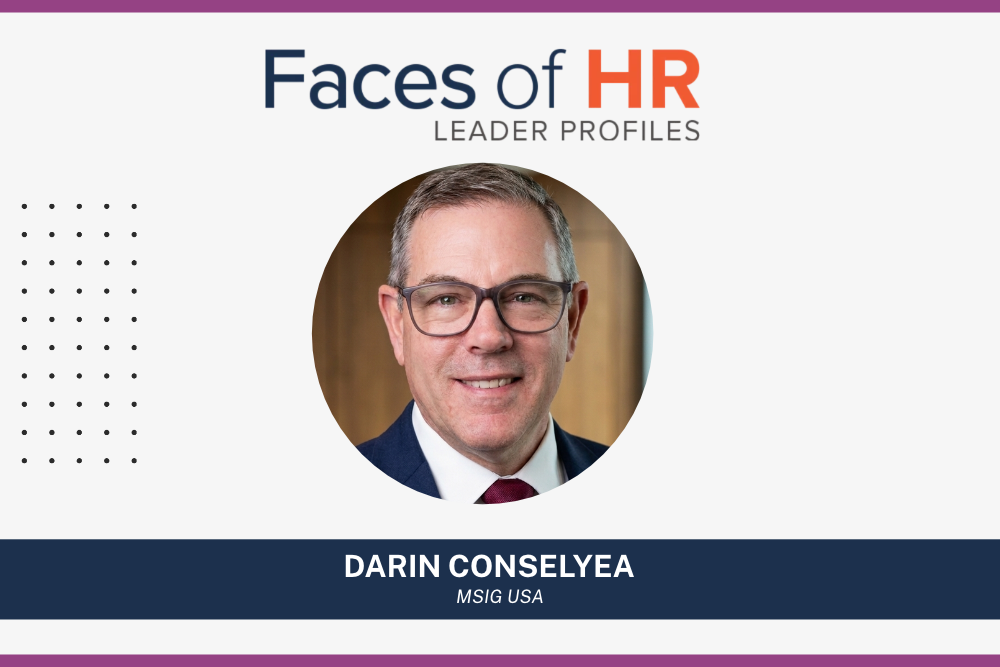
While earning his B.A. in Business Management from Pace University at night, Darin Conselyea worked for a beverage distributor and earned his commercial driver’s license. That license landed him at United Parcel Service, where he joined the safety department, and where senior HR leaders first encouraged him to explore more opportunities within the function.
A Philosophy Built on Business First
What drew him in was seeing how much influence HR could have when it understood both the business and its people. That insight shaped his core philosophy: understand the business first, then determine how people strategy can move it forward.
A Track Record of Global Leadership
Today, Conselyea serves as Chief Human Resources Officer at specialty P&C insurer MSIG USA, capping a career that spans multiple industries, continents, and more than 25 years. Along the way, he has held leadership roles at Guardian Life, Barclays, Prudential Financial, and MetLife, including internation assignments in Japan and Ireland.
The Power of Taking Thoughtful Risks
Looking back on his journey, Conselyea’s advice for professionals is simple yet powerful: take thoughtful risks and bet on yourself. The experiences that shaped him most came from stepping into unfamiliar roles, moving across the globe, or saying yes before feeling completely ready.
“Go in with your eyes open, but don’t let uncertainty keep you from moving forward.”
In our latest Faces, meet Darin Conselyea.
Who is/was your biggest influence in the industry?
Several leaders influenced me at different stages of my career. Early on, one manager told me not to “let the grass grow under me,” to keep seeking new experiences and stretch beyond what I knew. Others gave me opportunities to work with C-suite executives and take roles abroad.
I also worked for a CHRO who showed me that strong leadership and genuine empathy can coexist. I’ve carried those lessons with me: stay curious, understand the business, create opportunities for others and never lose sight of the people behind the work.
What’s your best mistake and what did you learn from it?
Early in my career, I sometimes mistook speed for progress. I’ve always had a strong bias for action, and when I could see where a business needed to go, my instinct was to move quickly and assume others would follow. I learned that having the right answer isn’t enough. People need to understand where you’re going, why it matters and how they can be part of getting there. I still have that bias for action, but I pair it with communication and shared ownership.
What’s your favorite part about working in the industry? What’s your least favorite part, and how would you change it?
My favorite part is taking a business challenge and determining how people strategy can help solve it. Talent management is especially rewarding: identifying people with potential, helping them recognize strengths they may not see and watching what they accomplish.
My least favorite part is administrative work that consumes time without adding strategic value. Technology and AI can simplify routine work and give HR more capacity to advise leaders, develop talent and address complex workforce challenges. The goal is more time for human judgment and relationships.
It sounds like through your experience you really care about people, and you want to help them feel safe and comfortable, which is important in the industry. Please elaborate here.
I care deeply about creating an environment where people feel supported, though support doesn’t always mean making people comfortable. Some of the most meaningful growth happens when someone is given an opportunity that stretches them.
As a leader, I try to recognize potential, sometimes before someone sees it themselves, and create opportunities to test it. That might mean a stretch assignment, a new role or a challenge that requires applying their skills in a different way. The key is giving people trust and ownership while making sure they can ask questions and acknowledge when they need help.
How can company leaders make HR a value within their organization?
It starts with treating HR as part of the business strategy, not as a function that comes in after decisions are made. When leaders bring HR into conversations about growth and transformation early, HR can help shape how the business gets there. HR also has to earn that seat by understanding how the business operates and identifying the capabilities needed to move priorities forward.
The strongest partnership happens when business strategy and people strategy are developed together. That’s when HR becomes a driver of how an organization grows, changes and performs.
Where do you see the industry heading in five years? Or are you seeing any current trends?
Five years is a long horizon given how quickly work is changing. The future is already arriving, particularly with AI, reshaping how work gets done and the skills organizations value.
HR has to help employees build the skills to work differently today, and that means meeting people where they are. The bigger opportunity is using technology to reduce administrative tasks and give people more capacity to apply judgment and solve complex problems.
What are you most proud of?
One experience from my time at UPS has stayed with me for more than 30 years. We were struggling to recruit women into driver roles, and my manager believed we couldn’t sit in the office and wait for candidates to find us. He took us into the community to look for talent differently.
One day at a diner, I watched our waitress work, on her feet for hours, lifting and carrying constantly, and realized she already demonstrated many of the qualities the job required. We recruited her, and she became a UPS driver.
That inspired me to create a program called Driving Women, going to women’s softball games and other places to reach women we weren’t finding through traditional recruiting channels. The program was recognized for its success, but what I’m most proud of is the idea behind it.
It taught me that talent doesn’t always arrive in the package you expect. Sometimes leadership means looking beyond the résumé and giving someone the chance to prove it.
Do you have any advice for people entering the profession?
Learn the business, not just HR. Understand how your company makes money, what its customers value and what drives performance. That knowledge makes you a more credible partner. And stay curious and empathetic. Listen to people and understand how business decisions affect them.