




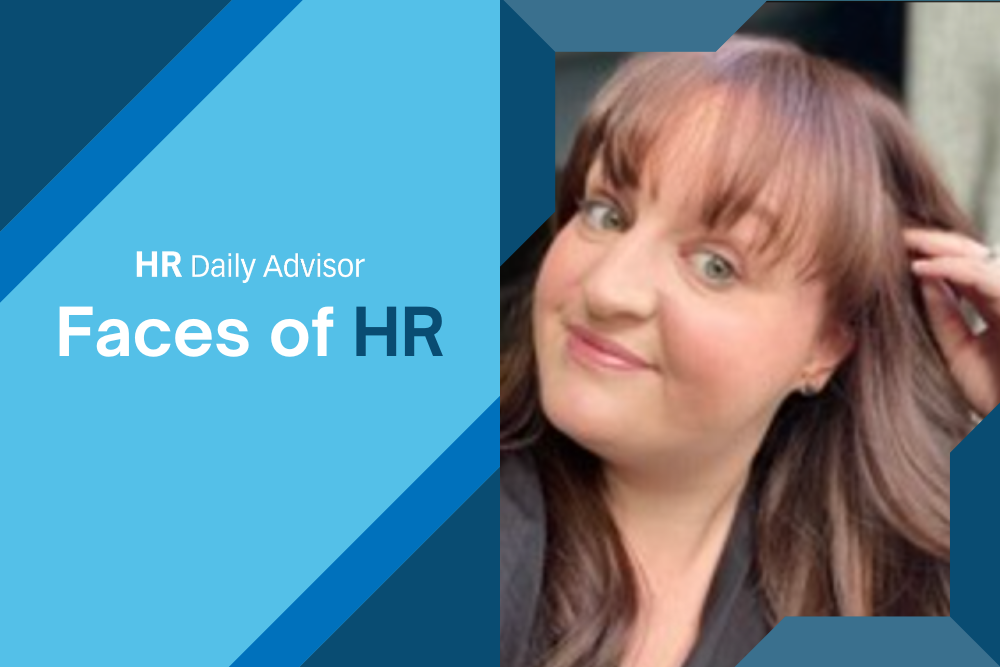
Erin Goodey doesn’t just manage global teams—she helps them thrive. As Director of People Services at Oyster, Goodey leads complex, cross-border employment strategies that empower high-growth companies to scale compliantly, humanely, and with total clarity.
Known for her practical, no-nonsense approach, she specializes in global people operations, risk mitigation, and pragmatic frameworks for distributed teams. By partnering closely with founders and HR leaders, she turns international expansion and workforce design from a risky puzzle into a powerful competitive advantage.
A Purpose-Driven Start
Goodey’s path to the C-suite started far from the traditional corporate ladder. She began her career in the non-profit sector supporting criminalized and marginalized women and girls—helping them rebuild their lives post-incarceration by securing housing, counseling, and employment.
“I always wanted to work with people in some capacity, and that was my first foray into it.”
When she later transitioned into a new sector during a period of organizational transformation, her role naturally involved heavy “peripheral” HR work. That momentum quickly shifted her into a full-time People role focused on culture, engagement, and corporate social responsibility (CSR)—bringing her passion for supporting people and making a community impact directly into the workplace.
Navigating the Next Era of HR
Looking ahead, Goodey sees an industry standing at a massive turning point driven by global hiring, evolving regulations, and AI.
Her key takeaway for modern leaders? Design with intention.
“The companies that do will move faster, scale more sustainably, and create better experiences for their teams. The ones that don’t will spend a lot of time untangling complexity they didn’t plan for.”
As the world of work evolves over the next 12 to 24 months, Goodey remains fiercely optimistic for the organizations leaning into this moment—using global employment not just as a logistics exercise, but as a strategic lever for growth.
In our latest Faces, meet Erin Goodey.
Who is/was your biggest influence in the industry?
Less a single person, more a type of leader. People who treat People/HR as critical org infrastructure, not support. The ones who understand how you hire, pay, manage, and scale people is as critical as product or revenue. I’ve learned the most from leaders who are comfortable operating in ambiguity and making judgment calls where there isn’t a clean answer, because that’s the reality of global People work.
What’s your best mistake and what did you learn from it?
Earlier in my career, I over-indexed on solving problems myself instead of building systems that prevented them. I was effective in the short term, but it didn’t scale, and it created dependency and near burn out. The shift was realizing that impact at a senior level isn’t about being the best problem-solver in the room. It’s about designing environments where problems are less likely to happen, and where others can solve them without you. There’s a real awakening when you realize you don’t need to solve everything yourself, but rather you should be empowering everyone to be the experts in their domains.
What’s your favorite part about working in the industry? What’s your least favorite part, and how would you change it?
My favorite part is the complexity. People often underestimate how nuanced global employment, culture, and operations really are. Global employment sits at the intersection of regulation, culture, and operations, and there’s no universal playbook or one-size-fits-all answer, and that’s what makes the work meaningful. Global employment done well unlocks access to talent and opportunity at a scale that just wasn’t possible before, so I love being able to play my part in that whether with my own team or in partnership with our customers.
Not really my least favorite part, but worth a little call out is how sometimes EOR is seen as just software and treated like a product purchased from a vendor that you can just plug and play. It’s not just software or packaged employment. It’s compliance, risk, and nuanced, country-specific decision-making. Ultimately it goes back to customer need, do you want/need a transactional solution, or do you want a strategic partner to support global scaling backed by expertise and judgement? It really needs to be treated more like infrastructure.
It sounds like through your experience you really care about people, and you want to help them feel safe and comfortable, which is important in the industry. Please elaborate here.
For me, “safe and comfortable” doesn’t mean easy; it means clear, fair, and consistent even when the environment may not always be easy or frictionless, which is common given the type of work the team is doing. It is about creating an environment that feels clear, fair, and consistent.
People feel psychologically safe when expectations are well-defined, decisions are transparent, and there’s accountability at every level. Ultimately, creating a sense of safety isn’t about removing accountability; it’s about making sure accountability is predictable, equitable, and grounded in something people can rely on.
A lot of what creates stress at work isn’t the work itself, it’s ambiguity, inconsistency, or feeling like decisions are arbitrary. Not knowing how decisions are made, what good looks like, or whether standards are applied evenly is where trust breaks down.
My focus is building systems and cultures where people understand how things work, what’s expected of them, and where they stand. It also means being honest, even when it’s uncomfortable. People don’t need everything to go their way, but they do need to understand the “why” behind decisions and feel like they’re being treated fairly.
When I talk about my own team, I describe my approach as the team’s biggest cheerleader, but equally the team’s biggest bodyguard. My role is to not only set them up for success, but ensure they’re getting the right exposure, they’re engaged, they’re making decisions, influencing, working cross-functionally to drive results and ultimately living & breathing our values. Equally, I’m there to filter and block noise from them so they can focus on what’s most important.
How can company leaders make HR a value within their organization?
They have to stop treating HR as a downstream function and start treating it as a strategic pillar of how the company grows. At its core, every business decision is a people decision: how you hire, where you hire, how you structure teams, how you pay, how you manage performance. If those things aren’t designed intentionally, they become constraints on growth very quickly. So, the shift starts when HR is brought into the conversation from the beginning.
There’s also a mindset shift, especially in SaaS and high-growth environments, around speed vs. sustainability. Growth often prioritizes moving fast, but without the right People infrastructure (clear leveling, compensation frameworks, global employment strategy, manager capability) you create hidden debt that slows you down later. HR, when positioned correctly, helps you scale without constantly reworking the foundation.
Finally, it’s about investing in HR with the same rigor as other functions. We wouldn’t expect a product or engineering team to scale without systems, tooling, and experienced leadership. The same applies here. When HR is resourced and empowered properly, it doesn’t just support the business, it actively drives better, faster, and more resilient growth. That’s when it stops being seen as a cost center and starts being recognized as a competitive advantage.
Where do you see the industry heading in five years? Or are you seeing any current trends?
Three big shifts:
- Global by default: Hiring across borders is no longer niche, but most companies are still underestimating the operational and compliance complexity that comes with it.
- AI + automation in People ops: Not replacing judgment but removing repetitive work so teams can focus on higher-impact decisions.
- Greater accountability for People outcomes: Metrics around engagement, performance, and retention will be treated with the same rigor as financial metrics.
The gap will be between companies that build intentional infrastructure for this and those that try to patch it together as they go.
What are you most proud of?
I’m most proud of building teams and systems that continue to operate and scale without becoming dependent on me. I’m also proud of shifting the perception of People teams from reactive support to strategic partners. Whether that’s embedding People into decisions around global expansion, improving how we approach employment infrastructure, or helping leaders think differently about org design and performance. I’ve been able to move the conversation from “HR as a function” to “People as a lever for growth.”
And at a more practical level, I’m proud of the moments where the work shows up in outcomes; things like teams that are more effective, managers who are more confident, employees who understand how to succeed, and fewer issues caused by ambiguity or inconsistency. It’s not always the most visible work, but it’s the kind that compounds over time and makes the entire organization stronger.
Do you have any advice for people entering the profession?
Don’t treat HR as policy and process; treat it as a business function. The more you understand how a company operates (revenue, product, risk, growth) the more effective you’ll be in shaping People strategies that work in the real world, not just in theory, so partner early, build relationships early, ask curious questions.
Early in your career, say yes more often than you say no. Get exposure to as many areas as possible. At the same time, don’t stay in execution mode for too long. Start building your decision-making muscle early. The counterbalance to all of this is boundaries. So, while it’s important to lean in and build experience, it’s just as important to know how to prioritize effectively and protect your time. You’ll be far more effective long-term if you’re operating with clarity and sustainability, rather than constantly reacting. That balance—curiosity and ownership, paired with strong boundaries—is what will allow you to grow.