




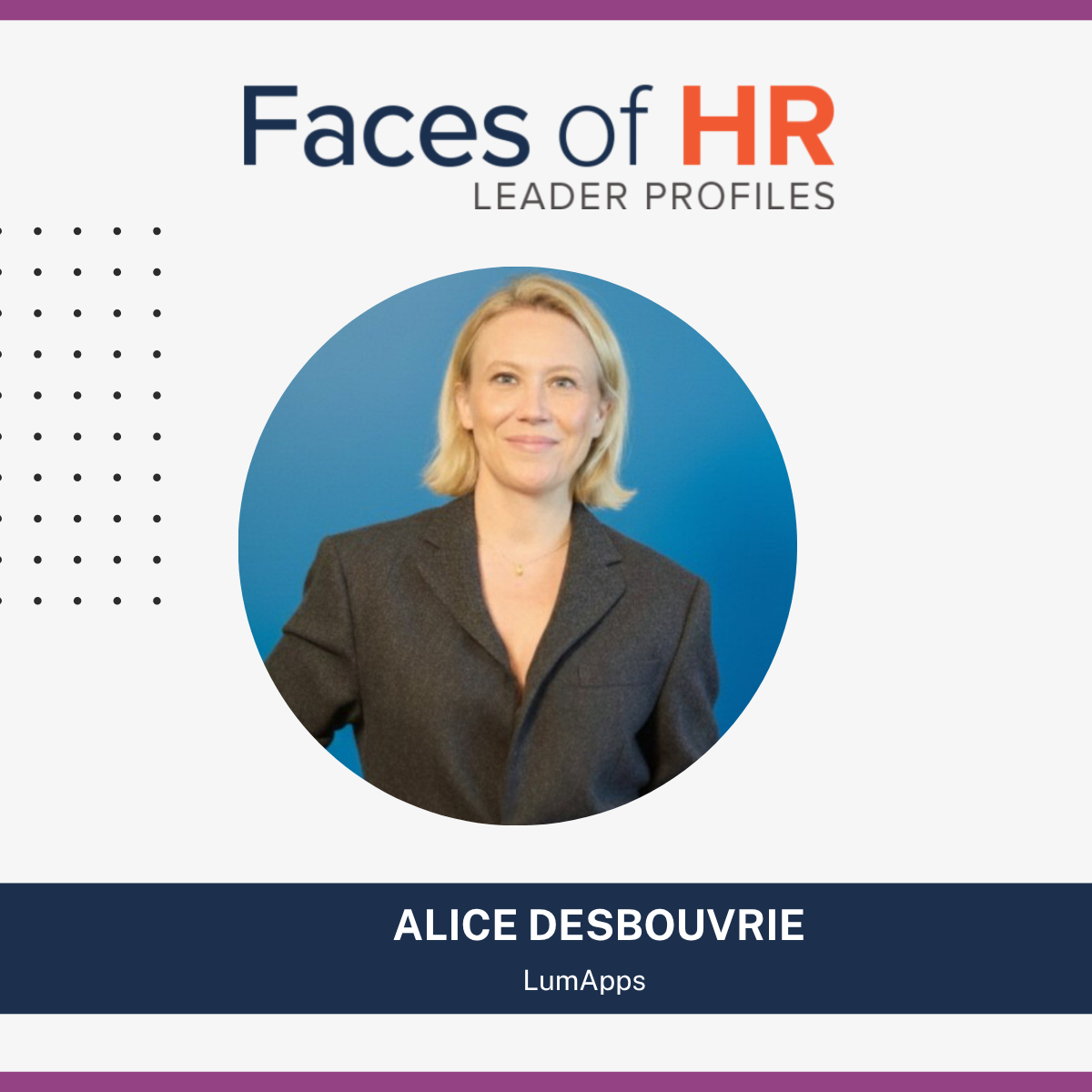
For Alice Desbouvrie, Chief People Officer at LumApps, HR isn’t just about processes—it’s about unlockable potential. Her path into the field stemmed from a deep fascination with economics and business management, where she quickly recognized a fundamental truth: a company’s success rests squarely on how its people are empowered to perform.
That realization launched her career in HR consulting, laying a strong foundation in organizational strategy and solving complex talent challenges across a variety of industries. She then transitioned into hands-on operational leadership within high-growth tech scale-ups. In those fast paced environments, she honed her ability to build, structure, and scale HR teams and functions completely from the ground up.
Today, what drives her most is cracking the code on employee engagement. She spends her energy discovering the exact levers that help employees thrive while simultaneously propelling business performance.
By crafting a cohesive ecosystem—spanning total rewards, career development, and well-being programs—Desbouvrie’s focus remains clear: designing an employee experience that directly powers broader company success.
“For me, creating an environment where people feel genuinely fulfilled and aligned with the company’s success is the most rewarding part of the job,” she shared with HR Daily Advisor.
In our latest Faces, meet Alice Desbouvries.
What is the biggest lesson you’ve learned in your career? Was there a mistake, defining moment, or experience that changed the way you approach your work?
Every single time I thought I had the answer in advance and tried to roll out an HR solution without deeply involving business leaders from day one, I was wrong.
The single biggest lesson of my career is that effective HR strategies are never designed in a tower—they are co-created with executive leaders and managers on the ground. You have to listen, understand their operational reality, and build solutions with them, not for them. To me, there is simply no other way to do this job successfully.
What would you like to see evolve within the HR function?
What I’d love to see evolve in HR is making innovation a day-to-day priority. HR teams are often caught up in operational complexity, but we need to create dedicated space and time for genuine innovation, whether that means leveraging new technologies, experimenting with modern workplace models, or reinventing talent strategy. We should be driving the future of work, not just responding to it.
You seem committed to creating an environment where employees feel a strong sense of trust. What does that mean in practice for you?
For me, building trust means creating an empathetic environment that naturally fosters both individual and collective high performance. It breaks down into two essential pillars:
- Clarity and Purpose: Trust starts with transparency. It’s about giving employees a clear line of sight into the company’s strategy and helping everyone understand how their individual contributions drive that vision forward. When people know why their work matters and where the business is going, they feel empowered to take initiative.
- Collaboration over Silos: Individual brilliance can deliver short-term results, but sustainable, long-term performance is built together. Placing cross-functional collaboration at the heart of our ecosystem breaks down silos and creates a rich learning environment.
What role do business leaders play in making HR a true driver of business performance?
Business leaders view talent and organizational strategy as core drivers of enterprise performance. In practice, this means two key things:
- Integrating HR into Strategic & Operational Decisions: Executive leadership involves HR teams early in solving business, structural, and performance challenges. When people strategy is designed side-by-side with business strategy, execution becomes faster and far more effective.
- Leading Through Technological & Human Transformation: Major disruptions—especially those driven by AI—are fundamentally changing business models and how work gets done. However, technology alone doesn’t transform a company; people do. Leaders must partner closely with HR to guide these transformations, ensuring the organization scales its technological capabilities while actively evolving its talent and skills.
How do you see HR evolving over the next five years?
Over the next five years, I see HR evolving into a strategic orchestrator that sits at the center of organizational transformation. Specifically, this evolution will focus on two critical priorities:
- Architecting a hybrid ecosystem (Human + AI): HR will act as the custodian of the balance between technology and humanity. As digital tools and AI become deeply integrated into daily workflows, our role will be to design a seamless, hybrid collaboration model—one where technology amplifies human potential rather than replacing it, driving overall enterprise performance.
- Building Organizational Agility: With business models shifting at an unprecedented pace, market success will depend on adaptability. HR teams must lead the charge in building flexible, agile organizational structures and fostering a continuous learning culture—ensuring companies can pivot seamlessly in the face of major market and technological changes.
What are you most proud of in your career?
For me, pride is never a solo achievement—it’s strictly collective.
What makes me proudest is that feeling when my team and I successfully deliver our roadmap alongside business leaders, seeing our talent strategy drive tangible growth for the enterprise.
I also take pride in seeing concrete progress on diversity and equity—when our gender balance metrics improve and our culture becomes more inclusive. Knowing that we are building a high-performing organization while moving the needle on diversity and inclusion is a real reward.
What advice would you give to someone starting a career in HR?
My biggest advice is for HR collaborators to step out of the traditional “people execution” box and act as business co-pilots. That means deeply understanding the company’s P&L, unit economics, and operational bottlenecks, not just the talent metrics.
When you approach HR with a business mindset, you stop pitching “HR initiatives” and start solving business problems through human capital.