



Sarah Devereaux, HCI Leadership Coach and Advisor, and former Head of Executive Development at Google, opened her SPARK HR session with a startling reality check: HR is carrying a massive burden. Between market shifts and organizational restructuring, the pressure to find solutions is at an all-time high. However, the “laser focus” HR leaders have relied on for decades might actually be the thing that’s holding them back.
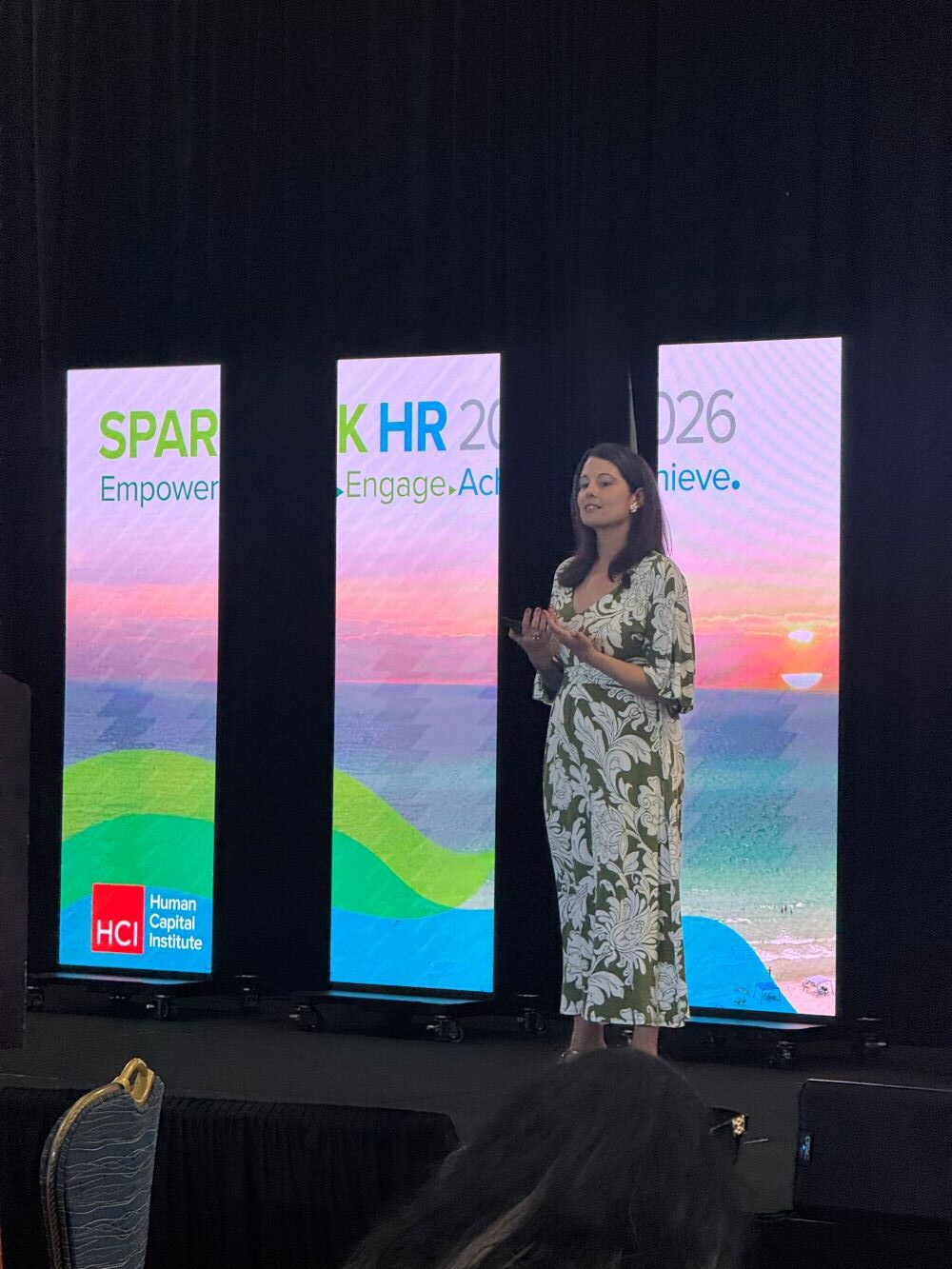
With 15 years at Google, plus a side career in local politics and 20 acres of farmland, Devereaux has seen how complex systems function (and fail) across every level of society. She argues that in today’s world of “the three Rs” (RIFs, reorgs, and restructures), the old HR playbooks are no longer a good fit. To lead effectively, HR professionals must learn to widen their lens and start looking at the whole.
The Metaphor: Efficiency vs. Survival
The core of the session centered on a powerful visual: a racehorse wearing blinders. Blinders help a horse run fast and stay focused, but they strip away its natural 360-degree vision—the very thing it needs to sense threats and survive.
“In HR, we don’t call them blinders. We call them ‘laser focus,’ ‘staying in your lane,’ or ‘avoiding scope creep,'” Devereaux noted. “But when we narrow our field of vision, we miss the systemic signals. We take away our natural ability to survive and thrive.”
The 4 Key Pillars of Systems Leadership
1. Optimize for the Whole, Not the Part
When we wear organizational blinders, we tend to make siloed decisions. We solve a “local” problem for our specific team without considering the downstream effects.
- Sarah’s Insight: True systems thinking means making systems-conscious decisions that account for how one change impacts the entire interconnected ecosystem.
2. Stop Mistaking Momentum for Progress
The pressure to show “tangible results” often leads HR to start “checking boxes.” But Devereaux warned that barreling ahead with a solution before you truly understand the problem is just movement, not growth.
- Sarah’s Insight: Don’t trade real, sustainable progress for a quick win that doesn’t solve the root cause.
3. Use the “Five Features” to Diagnose Fractures
To help leaders move from “broken” to “functional,” Devereaux shared her foundational framework for diagnosing any system:
- Common Purpose: Is the goal clear to everyone?
- Boundaries: Are the guardrails in place?
- Connections: What is the level of trust and shared mindset?
- Inputs/Outputs: What are we putting in vs. getting out?
- Feedback Loops: Is the system learning and adapting?
4. Move from Certainty to Clarity
HR often chases “certainty” through rigid rules and playbooks. However, in an era of AI displacement and market shifts, certainty is an illusion.
- Sarah’s Insight: Focus on Clarity. Clarity comes from holding the complexity of the “whole” rather than focusing on a snapshot of the “parts.”
The “Nudge”: HR’s Post-Conference Experiment
Devereaux wrapped up by introducing Nudges—safe-to-try experiments designed to move a system forward without the risk of a total overhaul.
The Challenge: Identify one area where you’ve been “staying in your lane” at the expense of the bigger picture. This week, take one small, low-risk step to involve a different perspective. That’s your first nudge toward taking off the blinders.
“In highly interconnected, complex environments, narrowing our field of vision comes with a high cost. We have to widen the lens, even if it feels overwhelming.” — Sarah Devereaux