Tag: AI

Faces of HR: How Equifax’s Chris Johnson is Making HR the Hero

Chris Johnson isn’t your typical HR leader—and that’s his superpower. As Senior Vice President and General Manager of Employer Services at Equifax Workforce Solutions, Johnson leads a team dedicated to providing HR professionals with people-driven, data-powered solutions. His goal? Take the heavy lifting out of HR compliance so employers can spend less time on administration and […]
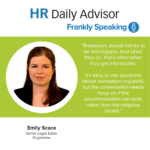

HRDA Frankly Speaking: HR Leadership Shouldn’t Include Theology

Religious exemptions requests of AI are growing by the day. Since May, when the Vatican released an encyclical offering criticism on AI and its use, several instances of employees successfully acquiring religious accommodations to avoid using AI have been popping up, and likely many more to follow. What does this mean for employers? Well, thanks […]

The AI Adoption Gap is Now HR’s Biggest Workforce Risk

A CFO uses an AI assistant to draft a board update before the Monday morning meeting ends. Down the hall, employees performing similar knowledge work remain stuck with old processes because access, training, managerial support, and incentives never arrived. That divide exposes the real AI adoption gap: companies can appear technologically advanced while most daily […]

HRDA Frankly Speaking: AI Exemptions Only Growing

With Pope Leo XIV releasing an encyclical back in May, largely condemning the use of generative AI, we’ve seen cases begin to surface of employees asking for religious accommodations to exempt them from using AI in their roles. And employers are having to comply. As AI use grows, so too does it’s many compliance issues. […]

HRDA Frankly Speaking: Are You Automating Away Your Team’s “Quick Wins”?

Many HR leaders are rushing to use AI to automate routine, repetitive tasks. The goal seems obvious: clear out the busy work so employees can focus entirely on high-value, complex projects. But Kevin Bishop, Director of Talent Development at LinkedIn, warns that this approach might accidentally be driving your team straight toward burnout. In a […]

New Stanford Study Reveals Bias in AI Hiring Tools, Raises Stakes for Employers

A recent study by Stanford University’s Institute for Human-Centered Artificial Intelligence (HAI) provides new large-scale evidence that artificial intelligence (AI) hiring tools can produce racially disparate outcomes. For employers increasingly relying on automated screening to manage applicant volume, the study raises significant legal risk, particularly under long-standing disparate impact principles. Details The Stanford researchers analyzed […]

Job Redesign Is HR’s Real AI Mandate Now  

A recent eight-month field study at a 200-person U.S. tech company found that AI work expanded employees’ responsibilities, pushed work into breaks and evenings, and increased multitasking. The authors treat that pattern as a warning. For HR leaders, the more useful conclusion is sharper: AI does what serious productivity tools usually do. It raises capacity, then the […]

New AI-Related Executive Order Aims to Promote Innovation and Security

On June 2, 2026, President Trump signed Executive Order (EO) 14409, titled “Promoting Advanced Artificial Intelligence Innovation and Security,” which established the administration’s latest policy related to artificial intelligence (AI). EO 14409 reiterates the administration’s stated commitment to fostering AI innovation and addresses both cyber- and national security concerns as AI capabilities become increasingly advanced.  […]

AI is Creating HR Problems for Employers

AI Hiring Tools Can Violate FCRA  A recent lawsuit filed in California should raise serious concerns to any employer using artificial intelligence (AI) to screen applicants. The lawsuit, Kistler et al. v. Eightfold, AI Inc., claims the platform scraped personal data on over a billion workers, assigned each applicant a scored ranking, and filtered out lower-ranked […]

Faces of HR: How Carta’s Nick Avery Builds Future-Ready Workforces from the Ground Up

Nick Avery didn’t climb into the executive ranks through a traditional corporate fast-track. Back in the 1990s, structured HR graduate programs were rare, so he had to engineer his own path into the field. He started with a part-time operations role at an airline while finishing his degree, eventually finding his way into staff training […]